Every Child Deserves Safety: Standing Against Child Abuse in India
Every child deserves to grow up feeling safe, loved, respected and heard.
Childhood should be a time of learning, playing and dreaming about the future. Yet, for many children, the places where they should feel safest can become places of fear and harm.
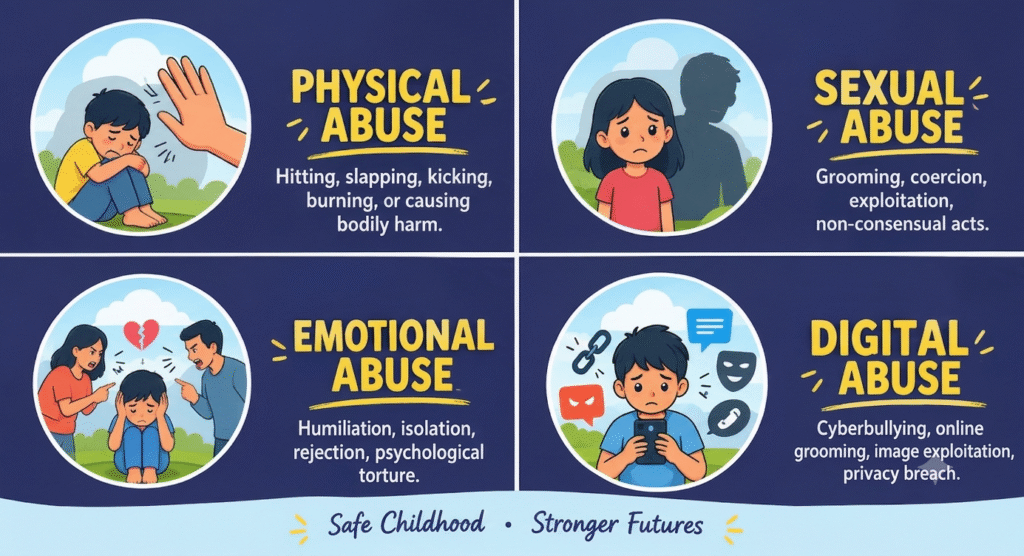
Child abuse is not limited to one form. It can be physical, sexual, emotional, psychological or digital. It can happen at home, at school, in the community or online. And sometimes, the person causing harm may be someone the child knows and trusts.
This is why prioritizing child safety in every sphere of life must be an uncompromising collective duty.
No form of child abuse should ever be ignored, justified or normalised.
Understanding Child Abuse to Ensure Child Safety
Physical Abuse and Corporal Punishment
Hitting, slapping, kicking or deliberately causing physical pain is abuse—not discipline.
Children need guidance and boundaries, but fear and violence should never be used to teach them.
Sexual Abuse and Exploitation
Child sexual abuse can happen to children of any gender, age or background. In many cases, the person responsible may be someone the child already knows. This highlights why child safety must be an ongoing, proactive priority in every household, school, and community.
Creating a safe environment where children can speak openly is one of the most important steps towards protecting them.
Emotional and Psychological Abuse
Abuse does not always leave visible injuries.
Constant humiliation, threats, insults, rejection, intimidation and severe neglect can deeply affect a child’s confidence and emotional well-being.
Invisible wounds are still wounds.
Child Labour and Child Marriage
Every child deserves the opportunity to learn, grow and enjoy their childhood.
Child labour and child marriage can take away education, freedom, safety and the opportunity to build a better future.
Online Abuse and Exploitation
Children are growing up in an increasingly digital world. Along with its benefits come risks such as cyberbullying, online grooming, harassment and exploitation. This makes digital child safety an essential part of modern parenting and education, requiring proactive supervision, open communication, and strict privacy boundaries.
Protecting children today means protecting them both offline and online.
Laws Matter—but Awareness Matters Too
India has laws designed to protect children, including the POCSO Act, 2012, the Juvenile Justice Act, 2015, and laws addressing child labour.
But laws alone cannot protect every child.
Children also need adults who listen, recognise warning signs, take concerns seriously and know when and how to seek help.
Silence should never become a shield for abuse.
What Can We Do?
Child protection begins with all of us.
Listen and Believe
Create an environment where children feel comfortable speaking about things that make them uncomfortable or afraid. Listen calmly and avoid blaming or shaming them.
Teach Children About Safety
Help children understand personal boundaries, safe and unsafe situations, and the importance of talking to a trusted adult when something feels wrong.
Pay Attention
Sudden changes in behaviour, fear, withdrawal or distress should not automatically be dismissed. One sign does not prove abuse, but concerns deserve attention.
Promote Online Safety
Talk to children about privacy, responsible internet use and the risks of interacting with strangers online. Digital safety should be built on awareness and trust.
Important Child Safety Resources in India
Child Helpline: 1098
For children who need care, protection or assistance.
Emergency Response: 112
For immediate emergency assistance.
Cyber Crime: 1930 / cybercrime.gov.in
For reporting cybercrime and certain online incidents.
If a child is in immediate danger, seek emergency assistance without delay.
Why Child Safety Is Every Child’s Fundamental Right
Protecting children is not the responsibility of parents alone.
It belongs to families, schools, communities, authorities—and each one of us.
We need to listen when children speak.
We need to notice when something feels wrong.
We need to speak up when a child is at risk.
And most importantly, we need to stop treating any form of abuse as “normal”, “discipline” or a private family matter.
At Voice for Children, we stand for a childhood where every child can grow with dignity, safety and hope.
Listen. Believe. Protect. Speak up.
Because every child deserves safety. Every child deserves respect. And every child deserves to be heard.